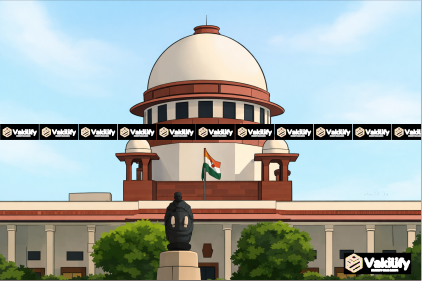


The Supreme Court is currently reviewing Governor powers under Article 200, following a Presidential reference that challenges its earlier ruling on bill assent timelines. In response to political sparring during the hearing, the Constitution Bench clarified that its decision will remain unaffected by which party holds power—past or present. This clarification reinforces the Court’s commitment to constitutional neutrality and procedural integrity.
📜 Case Background: Presidential Reference on Governor Powers
| Detail | Description |
|---|---|
| Reference Made By | President Droupadi Murmu |
| Legal Provision | Article 143 of the Constitution |
| Triggering Case | State of Tamil Nadu v Governor of Tamil Nadu & Anr. |
| Key Articles Involved | Article 200 and Article 201 |
| Bench | CJI BR Gavai, Justices Surya Kant, Vikram Nath, PS Narasimha, Atul S Chandurkar |
| Issue | Judicial timelines for assent to State bills |

The reference raises constitutional questions about whether the judiciary can impose procedural timelines where the Constitution is silent.
⚖️ Governor Powers Under Article 200, 201: What’s at Stake
“We are not going to decide the matter on the basis of which political dispensation is in power or was in power.” — CJI BR Gavai
- Article 200 allows the Governor to assent, withhold, or reserve a bill
- Article 201 governs the President’s assent when a bill is reserved
- The April ruling held that indefinite delays violate democratic principles
- The Court emphasized that constitutional silence cannot justify stalling governance
🔍 Key Questions Raised in the Presidential Reference
- Can courts prescribe timelines where the Constitution is silent?
- Is the Governor bound by the Council of Ministers’ advice under Article 200?
- Are decisions under Articles 200 and 201 subject to judicial review?
- Does imposing timelines infringe on executive discretion?
For a full list of the 14 questions referred, see The Hindu’s breakdown.
💬 Vakilify Insight
This reference tests the boundaries of judicial activism and constitutional interpretation. The Supreme Court must balance democratic accountability with executive discretion, especially when unelected Governors delay bills passed by elected State legislatures.
🔗 Related Reading and Links