
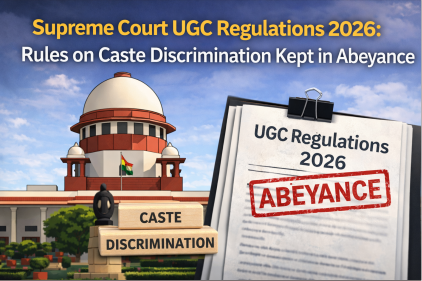
The Supreme Court has kept the UGC Regulations Supreme Court case in abeyance, raising concerns about exclusionary provisions that deny grievance redressal to general category students. The bench led by CJI Surya Kant observed that unchecked implementation could divide society and ordered that the rules be examined by an expert committee.
📜 Case Background: Advocate Suspended by BCI for Contemptuous Conduct
| Detail | Description |
|---|---|
| Regulation | UGC Promotion of Equity in Higher Education Institutions Regulations, |
| Notification Date | January 13, 2026 |
| Bench | CJI Surya Kant and Justice Joymalya Bagchi |
| Order | Regulations kept in abeyance; notice issued to UGC and Central Government |
| Next Hearing | March 19, 2026 |
The Regulations were challenged for excluding general category students from filing complaints under the grievance redressal mechanism. Petitioners argued that this framework amounts to impermissible State discrimination under Article 14.
🧑⚖️ Supreme Court’s Observations
The Court warned that unchecked implementation could divide society and have grave consequences.
Sections 3(c) and 3(e) were flagged as incongruent:
- Section 3(c) defines caste-based discrimination narrowly (SC/ST/OBC only).
- Section 3(e) defines discrimination broadly, covering religion, race, caste, gender, place of birth, and disability.
The bench questioned why Section 3(c) exists when Section 3(e) already subsumes caste discrimination.
The Court directed that the matter be examined by an expert committee to avoid exploitation of vague language.
📌 Petitioners’ Arguments
- Advocate Vishnu Jain argued that general category students are excluded from protection.
- Denial of grievance redressal based on caste identity amounts to State-sponsored discrimination.
- The plea contended that the Regulations encourage hostility against non-reserved categories.
💬 Vakilify Insight
This case highlights the delicate balance between affirmative action and constitutional equality. While the Regulations aim to promote equity, the Supreme Court has emphasized that progressive legislation must not regress into exclusionary frameworks. The upcoming hearing on March 19 will be crucial in determining whether the UGC must redraft its rules to ensure inclusivity for all students.
🔗 Related Reading and Links